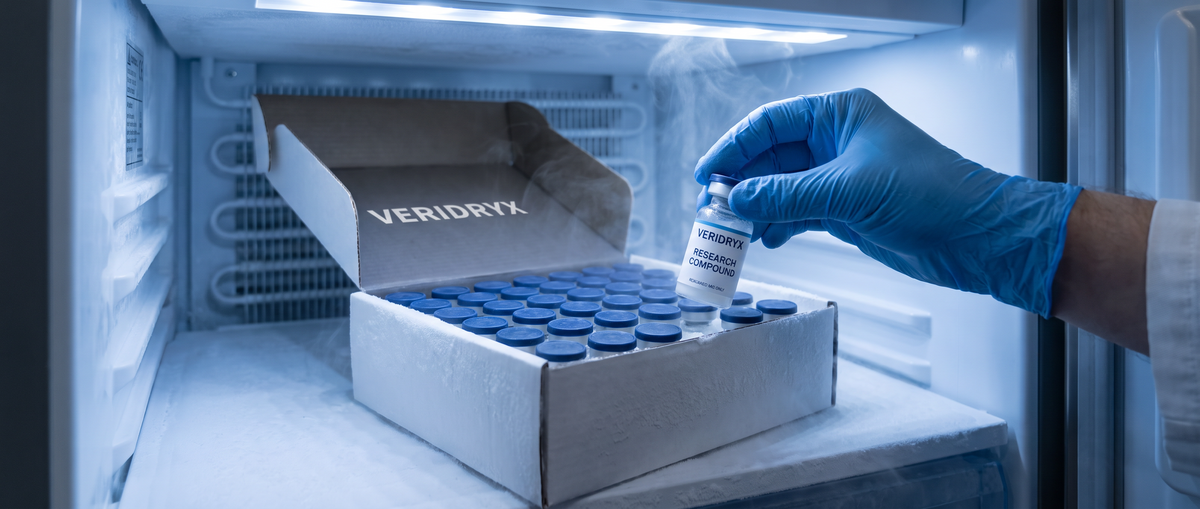
Key takeaways
- Store unopened lyophilized peptides cold, dry and away from light.
- −20 °C is the usual long-term condition; 2–8 °C is common for short periods.
- Let a cold vial reach room temperature before opening to limit condensation.
- Moisture and repeated temperature cycling are the main causes of degradation in storage.
- Record lot numbers and storage conditions in your lab notebook.
Lyophilization (freeze-drying) removes water so a peptide can be stored as a stable solid. Stability still depends on how the vial is stored once it reaches your lab.
Temperature
For long-term storage, most lyophilized peptides are kept at −20 °C or colder. Refrigeration at 2–8 °C is often acceptable for short periods. Always follow the storage condition on the label and the product’s documentation, which take precedence over general guidance.
Moisture
Lyophilized powders are hygroscopic: they pick up water from the air. Absorbed moisture speeds up hydrolysis and aggregation. Keep vials sealed until use, and let a cold vial warm to room temperature in a desiccator before opening, so condensation does not form on the powder.
Light and oxygen
Residues such as tryptophan, methionine and cysteine are prone to oxidation, and some sequences are light-sensitive. Store vials in their outer packaging or in the dark, and keep them sealed to limit air exposure.
Temperature cycling
Repeated warming and cooling exposes the material to condensation each time. If your work needs small amounts over a long period, plan your use so that each vial is opened as few times as possible.
Documentation
- Record the lot number, date received and storage location for every vial.
- Note any excursion from the labeled storage condition.
- Keep the certificate of analysis for the lot with your records.
Frequently asked questions
Can lyophilized peptides be shipped without ice?
Many lyophilized peptides tolerate short periods at ambient temperature in transit. Move them to the labeled storage condition as soon as they arrive.
Is a frost-free freezer suitable?
Frost-free freezers cycle temperature to defrost. A manual-defrost freezer gives a more stable environment for long-term storage.
How do I know a stored lot is still within specification?
Only re-testing can confirm that. Storage records help you decide when re-testing is needed.
Disclaimer. This article is for research and educational purposes only. It describes laboratory and analytical practice and is not medical advice. It contains no dosing, administration or human-use guidance. Veridryx products are sold for laboratory research use only and are not for human or veterinary use.
References
- ICH Q1A(R2) Stability Testing of New Drug Substances and Products. International Council for Harmonisation.
- USP General Chapter <659> Packaging and Storage Requirements. United States Pharmacopeia.