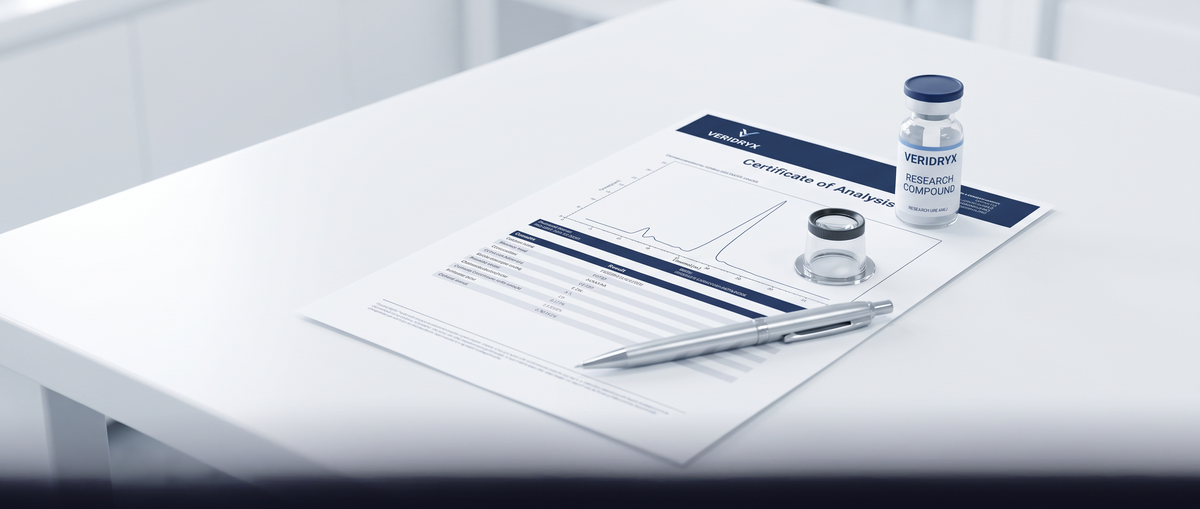
Key takeaways
- A certificate of analysis (COA) reports test results for one specific lot.
- Always match the lot number on the certificate to the lot number on the vial label.
- HPLC purity and mass-spec identity answer different questions; you need both.
- Net content, endotoxin and residual solvents are separate tests and may not appear on every COA.
- Check the test date and the laboratory named on the report.
A certificate of analysis is the document that connects a vial to data. It records which tests were run on a lot, how they were run, and what was found. Reading one well takes a few minutes and avoids most documentation problems later.
Start with the header
The header identifies the material and the lot. Look for:
- Product name and sequence or structure. Confirms the certificate describes the compound you ordered.
- Lot (batch) number. This must match the lot number printed on your vial label. A certificate for a different lot tells you nothing about your vial.
- Test date and report date. Results describe the lot when it was tested.
- Testing laboratory. The lab that ran each analysis should be named.
Purity by HPLC
High-performance liquid chromatography separates the components of a sample. Purity is usually reported as the main peak’s area as a percentage of total peak area at a stated UV wavelength (often 214 or 220 nm for peptides). A good certificate shows the chromatogram and the method conditions: column, mobile phases, gradient and wavelength.
Remember that HPLC purity is a relative measure. It does not tell you the identity of the main peak, and it does not tell you how much material is in the vial.
Identity by mass spectrometry
Mass spectrometry measures the molecular mass of the main component. The certificate should list the expected (theoretical) mass and the observed mass. Close agreement supports that the main component is the intended molecule.
Other results you may see
| Test | What it tells you |
|---|---|
| Net peptide content | How much of the powder is the peptide, as opposed to counter-ions and residual water. |
| Endotoxin (LAL) | Bacterial endotoxin level, reported in EU/mg. Relevant for cell-based work. |
| Residual solvents (GC) | Traces of solvents left from synthesis and purification, in ppm. |
| Water content | Moisture in the lyophilized powder, often by Karl Fischer titration. |
| Appearance | A description of the lyophilized cake. |
A quick checklist
- The product and lot number match your vial.
- Each result names its method.
- The chromatogram is included with the purity result.
- Observed and expected mass are both listed.
- The testing laboratory and test date are stated.
Frequently asked questions
Is a COA the same as a specification sheet?
No. A specification sheet lists the limits a lot must meet. A COA lists the results a specific lot actually achieved.
What if my lot number is not in the library?
Contact the supplier with the lot number and ask for the certificate for that lot.
Does high HPLC purity mean the vial contains the stated amount?
No. Purity and net content are different measurements.
Disclaimer. This article is for research and educational purposes only. It describes laboratory and analytical practice and is not medical advice. It contains no dosing, administration or human-use guidance. Veridryx products are sold for laboratory research use only and are not for human or veterinary use.
References
- USP General Chapter <621> Chromatography. United States Pharmacopeia.
- ICH Q2(R2) Validation of Analytical Procedures. International Council for Harmonisation.
- ICH Q6B Specifications: Test Procedures and Acceptance Criteria for Biotechnological/Biological Products.