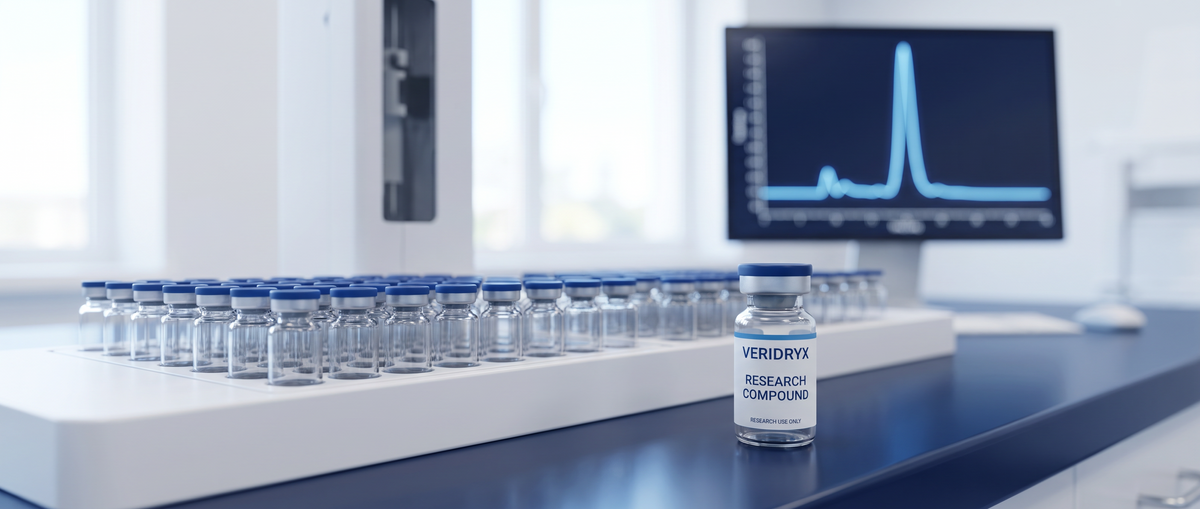
Key takeaways
- Reversed-phase HPLC is the standard method for peptide purity.
- Purity is the main peak’s share of total peak area at a stated wavelength.
- Method conditions affect the result, so they belong on the report.
- The chromatogram shows what the number cannot: shoulders, co-eluting peaks and baseline noise.
High-performance liquid chromatography (HPLC) is the workhorse method for checking the purity of synthetic peptides. Understanding how it works makes purity numbers much easier to interpret.
How reversed-phase HPLC separates peptides
A small sample is injected onto a column packed with hydrophobic particles, commonly C18. A gradient of water and acetonitrile, usually with an acid modifier such as trifluoroacetic acid, carries the sample through. More hydrophobic components stay on the column longer, so components leave at different times.
How purity is calculated
A UV detector records absorbance over time, typically at 214–220 nm where the peptide bond absorbs. Each component appears as a peak. Purity is the area of the main peak divided by the total area of all integrated peaks, expressed as a percentage.
Why the method matters
- Wavelength. Impurities that absorb weakly at the chosen wavelength are under-counted.
- Gradient and column. A shallow gradient can separate impurities that a steep one merges into the main peak.
- Integration. How small peaks and baseline are integrated changes the number.
That is why a purity result should always come with its method conditions and chromatogram.
Reading the chromatogram
- Find the main peak and its retention time.
- Look for shoulders or split peaks that may hide a co-eluting impurity.
- Check that small peaks are integrated and listed.
- Note the baseline: a noisy or drifting baseline makes small impurities harder to measure.
What HPLC does not tell you
HPLC purity does not confirm identity, and it does not measure net peptide content, water, counter-ions, endotoxin or residual solvents. Those need separate tests.
Frequently asked questions
What is a typical detection wavelength for peptides?
Around 214–220 nm, where the peptide bond absorbs strongly.
Can two labs get different purity results for the same lot?
Yes, if they use different columns, gradients, wavelengths or integration settings. Compare methods before comparing numbers.
Why pair HPLC with mass spectrometry?
HPLC shows how pure the main component is; mass spectrometry shows what it is.
Disclaimer. This article is for research and educational purposes only. It describes laboratory and analytical practice and is not medical advice. It contains no dosing, administration or human-use guidance. Veridryx products are sold for laboratory research use only and are not for human or veterinary use.
References
- USP General Chapter <621> Chromatography. United States Pharmacopeia.
- ICH Q2(R2) Validation of Analytical Procedures. International Council for Harmonisation.